Intent
The 2014 national curriculum for science aims to ensure that all pupils:
- Develop scientific knowledge and conceptual understanding through the specific disciplines of biology, chemistry and physics
- Develop understanding of the nature, processes and methods of science through different types of science enquiries that help them to answer scientific questions about the world around them
- Are equipped with the scientific skills required to understand the uses and implications of science, today and for the future.
At Batley Parish CE Academy, we understand the importance for lessons to have a skills-based focus, and that the knowledge can be taught through this. At Batley Parish, we aim to equip children with the knowledge required to use and implement Science today, tomorrow and for their futures. A high-quality Science education provides foundations for understanding the world. Therefore, by ensuring our pupils are building key knowledge and understanding concepts within our Science curriculum, our pupils recognise the power of rational explanation, develop a sense of curiosity about natural phenomena and develop respect for the environment and living things, including themselves and each other. At Batley Parish, we are committed to delivering a high-quality science education that inspires curiosity and promotes a love for learning about the world. Our science policy is built around the principles of the White Rose Science Scheme, which provides a structured and progressive approach to teaching science, ensuring that all pupils have the opportunity to develop essential scientific knowledge and skills.
Implementation
Teachers create a positive attitude to science learning within their classrooms and reinforce an expectation that all pupils are capable of achieving high standards in science.
Our whole school approach to the teaching and learning of science involves the following;
- Explicitly teaching and revisiting key vocabulary.
- Children are encouraged to ask their own questions and use their scientific skills and research to discover the answers. This curiosity is celebrated within the classroom.
- Planning involves teachers creating engaging lessons, often involving high-quality resources to aid understanding of conceptual knowledge. Teachers use precise questioning in class to test conceptual knowledge and skills, and assess pupils regularly to identify those children with gaps in learning, so that all pupils keep up.
- We build upon the knowledge and skill development of the previous years. As the children’s knowledge and understanding increases, and they become more proficient in selecting, using scientific equipment, collating and interpreting results, they become increasingly confident in their growing ability to come to conclusions based on real evidence.
- Working Scientifically skills are embedded into all lessons to ensure these skills are being developed throughout the children’s school career and new vocabulary and challenging concepts are introduced through direct teaching. This is developed through the years, in-keeping with the units.
- Events, such as project days and British Science Week, provide a broader provision encouraging the acquisition and application of knowledge and skills. These are purposeful, linking with the knowledge being taught in class and where appropriate involve the wider community.
Vision and Aims
Our vision for science education at Batley Parish is to cultivate inquisitive, knowledgeable and responsible learners.
We aim to:
- Foster a sense of wonder and curiosity about the natural world
- Equip pupils with the skills and knowledge to explore scientific concepts and processes
- Encourage critical thinking, problem-solving, and collaboration in scientific investigations
- Provide an inclusive environment that meets the diverse needs of all learners
Impact
The approach at Batley Parish results in a fun, engaging, high-quality science education that provides children with the foundations and knowledge for understanding the world. Our engagement with the local environment ensures that children learn through varied and first hand experiences of the world around them. Through engaging lessons and scientific enquiry, children have the understanding that science has changed our lives and that it is vital to the world’s future prosperity. Children learn the possibilities for careers in science, from a range of different scientists from various backgrounds, allowing all children to feel they are scientists and capable of achieving. Through a positive caring environment, we provide the opportunity for children to reach their full potential.
Curriculum Framework
- Alignment with National Curriculum
- Our science curriculum is aligned with the National Curriculum for England and follows the White Rose Science Scheme, covering the core areas of:
o Biology: Life processes, ecosystems, and human biology
o Chemistry: Properties of materials and changes in substances
o Physics: Forces, energy, light, sound, and Earth sciences
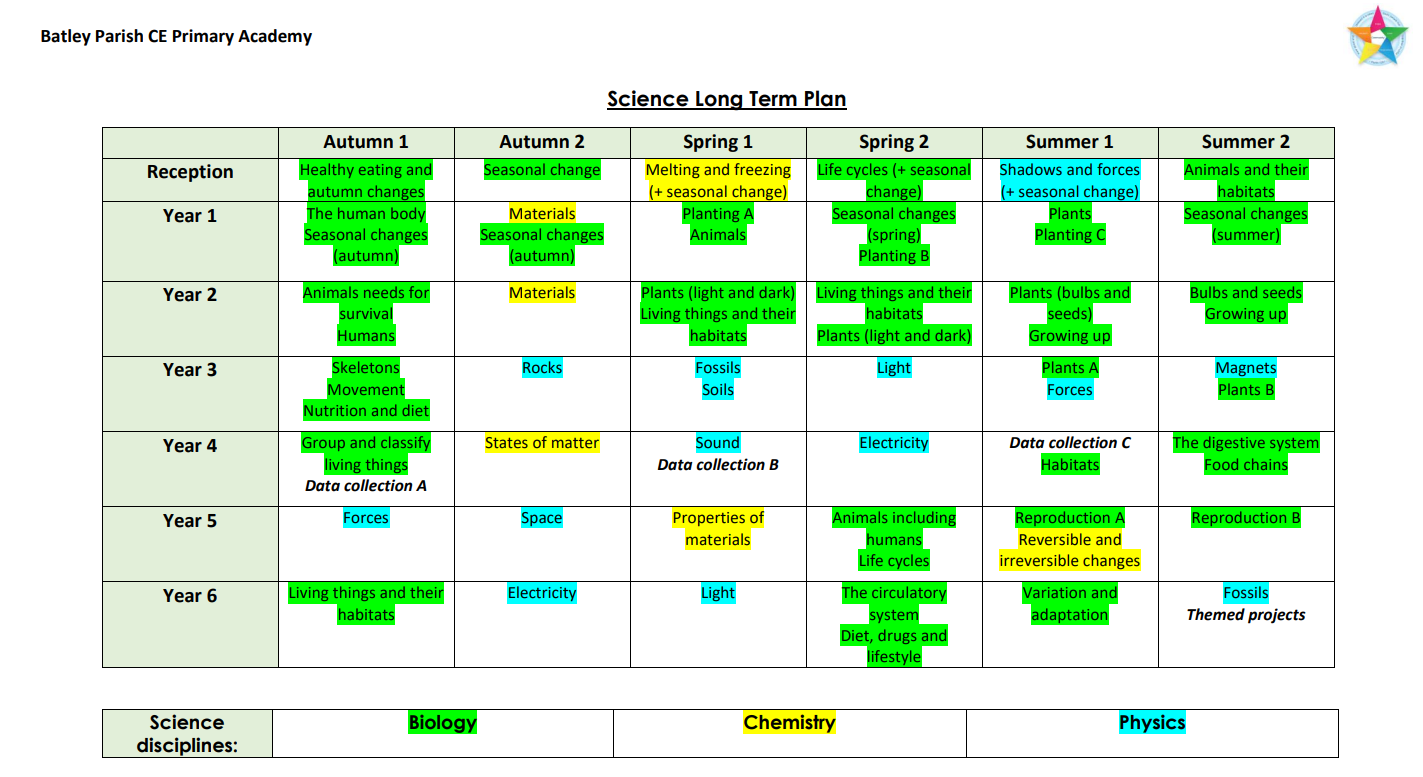
- These core disciplines are identified for each unit on the long term plan (see below.)
- We ensure that all pupils engage with a wide range of scientific topics throughout their time at school.
- Progression and Continuity
- The curriculum is designed to promote progression and continuity, with clear learning objectives for each year group.
- Yearly topics build upon prior knowledge, ensuring a coherent understanding of scientific concepts.
- Each lesson begins with a “flashback 4”, allowing children to recall prior knowledge. These questions revisit concepts from previous lessons, previous units and learning from previous year groups.)
- To support pupils to remember the key knowledge and vocabulary, each unit has a knowledge organiser. To support pupils further, each word (where appropriate) has been paired with a picture of reference.
- White Rose steps are condensed accordingly to ensure full curriculum coverage. The identified steps for each unit are located on the long term overview.
- Vocabulary has been mapped out progressively to align with the “key knowledge” statements and the National Curriculum.
- Cross-Curricular Links
- Science is integrated with other subjects, such as mathematics and English, to create a cohesive learning experience.
- Opportunities for cross-curricular projects will be identified to reinforce scientific learning and promote collaborative skills.
Teaching and Learning
- Active Learning
- We prioritise active learning strategies that engage pupils in hands-on experiments, investigations, and practical applications of scientific concepts.
- Pupils are encouraged to ask questions, hypothesise, and analyse results, fostering a culture of inquiry and exploration.
- Each lesson objective is written an enquiry question, to encourage children to think and ask their own questions.
- Adaptation
- Teaching methods and resources will be adapted to cater to the diverse needs of all pupils, including those with special educational needs and disabilities (SEND).
- Teachers will employ a variety of instructional strategies to ensure that every child can access the curriculum.
- Use of Technology
- Technology will be utilised to enhance learning, including interactive simulations, digital resources and data collection tools.
- Pupils will have access to a variety of online resources to support their scientific investigations and research (where appropriate.)
Assessment and Monitoring
- Assessment
- Regular formative assessments will be conducted to monitor pupils progress and understanding, providing feedback to inform future teaching.
- Assessment sheets are available for each unit that identify the “key knowledge” pupils need to know
- Each key knowledge statement is paired with an “assessment indicator.” These are used within lessons to identify whether pupils are secure with that statement.
- Where gaps or misconceptions are identified, opportunities to address these are planned into future lessons by the class teacher. These decisions are recorded on the assessment grids.
- Monitoring
- The science leader will monitor the implementation of the science curriculum and assess the quality of teaching and learning through lesson observations, pupils work scrutiny and feedback from staff and pupils.
- The impact of the science curriculum on pupils outcomes will be regularly evaluated, informing future planning and development.
Resources
- Physical Resources
- A variety of high-quality resources, including scientific equipment, and materials for practical experiments, will be provided to support teaching and learning.
- Classrooms will be equipped with the necessary tools for effective science education.
- Professional Development
- Ongoing professional development opportunities will be provided for staff to enhance their understanding of science teaching and the White Rose Science Scheme.
- Staff will attend staff meetings and will be encouraged to network with other schools to share best practice.
Health and Safety
- All science activities will be conducted following strict health and safety guidelines. Safety checks will be completed prior to experiments, and appropriate safety measures will be implemented.
- Pupils will be taught the importance of safety during science lessons and how to use equipment responsibly.
Parental and Community Engagement
- Parents will be informed about the science curriculum via the school website and encouraged to support their children’s learning at home through various activities and resources.
- Opportunities for community involvement, such as science days, guest speakers and school trips, will be explored to enrich the science curriculum.