Purpose of structure
Mathematics is a creative and highly interconnected discipline that has been developed over centuries, providing the solution to some of history’s most intriguing problems. It is essential to everyday life, critical to science, technology and engineering, and necessary for financial literacy and most forms of employment. A high-quality mathematics education therefore provides a foundation for understanding the world, the ability to reason mathematically, an appreciation of the beauty and power of mathematics, and a sense of enjoyment and curiosity about the subject.
Aims
The national curriculum for mathematics aims to ensure that all pupils:
- Become fluent in the fundamentals of mathematics, including through varied and frequent practice with increasingly complex problems over time, so that pupils develop conceptual understanding and the ability to recall and apply knowledge rapidly and accurately.
- Reason mathematically by following a line of enquiry, conjecturing relationships and generalisations, and developing an argument, justification or proof using mathematical language.
- Can solve problems by applying their mathematics to a variety of routine and non-routine problems with increasing sophistication, including breaking down problems into a series of simpler steps and persevering in seeking solutions.
At Batley Parish we use planning provided by the National Centre for Excellence in the Teaching of Mathematics (NCETM) and the White Rose Maths Hub.
Maths Mastery
The new current National Curriculum promotes a mastery approach to mathematical teaching and learning. In essence, this means that teachers try to keep their class learning about the same aspect of mathematics in a lesson but differentiate by deepening the learning that children experience. We have developed two ways of facilitating this:
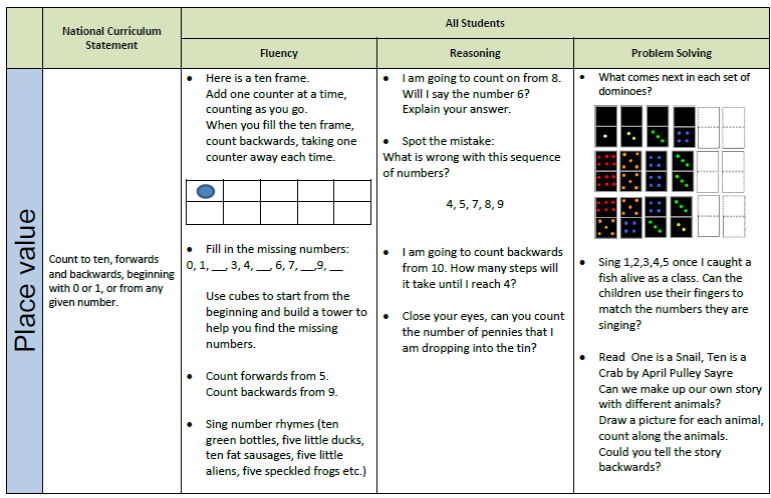
- Promoting the use of a fluency – reasoning – problem solving approach to our planning.
- Using Bloom’s revised taxonomy to differentiate learning.
Fluency – Reasoning – Problem solving
Fluency: More than simply the acquisition of basic mathematical knowledge and arithmetic skills, fluency involves being able to demonstrate the following skills:
- Efficiency – avoiding becoming bogged down in over complicated solutions.
- Accuracy – knowledge of number facts and relationships coupled with careful recording.
- Flexibility – having a toolkit of mental and written strategies suitable for the task at hand.
Bloom’s Revised Taxonomy
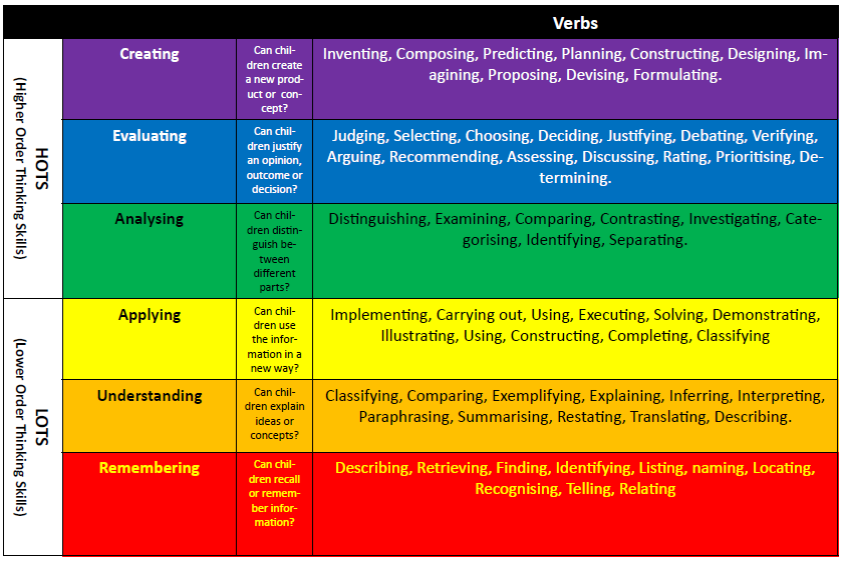
Bloom’s revised taxonomy is a way of categorising the thinking that is required to complete different types of learning tasks. These are divided into two groups:
- Higher Order Thinking Skills (HOTS)
- Lower Order Thinking Skills (LOTS)
The HOTS and the LOTS are divided into 3 further sub-groups as illustrated below. We use these to help us to differentiate learning in lots of curriculum areas, including maths.
Bar Modelling
The bar model is used in Singapore and other countries, such as Japan and the USA, to support children in problem solving. It is not a method for solving problems, but a way of revealing the mathematical structure within a problem and gaining insight and clarity as to how to solve it.